
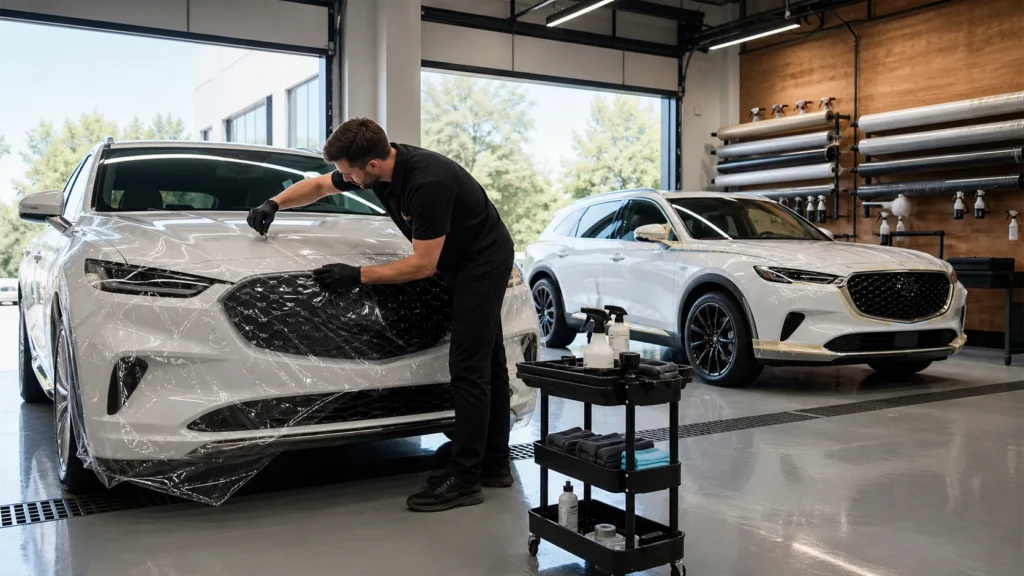
Protect Your Commute From Gatineau’s Worst Impact Zones
Daily drives across the Gatineau bridges and along Autoroute 5, 50, and 148 are tough on paint. You sit close to transport trucks, pass through gravel patches, and deal with winter sand and salt that stick around long after the snow is gone. All of that ends up flying straight at the front of your vehicle.
Those local conditions create very specific impact zones. The front bumper and grille take direct rock hits, the leading edge of the hood starts to chip, side mirrors get peppered, and lower rocker panels get sandblasted. Even the area around the windshield can get marked from debris kicking up at speed.
So the big question for drivers who live or work in Gatineau is simple: when it comes to paint protection film in Gatineau, is full front coverage actually worth it, or can a partial front do the job based on where damage really happens every day?
How Gatineau Bridges and Highways Attack Your Paint
Our local roads are hard on clear coat for a few reasons that show up again and again on commuter cars and SUVs.
Common debris sources include:
- Loose gravel and aggregate from road repairs and shoulder washouts
- Winter sand and small stones left behind into spring and early summer
- Salt and tiny chips from transport trucks on Autoroute 5 and 50
- Construction leftovers around bridge work and lane repairs
At highway speeds, those bits of debris follow pretty clear patterns:
- Lower front bumper and grille
This area takes the most direct hits. Rocks and gravel are thrown up by the vehicle in front of you, especially heavy trucks. The bumper is the first thing they meet.
- Hood leading edge (12 to 24 inches)
Debris that bounces upward after hitting the road or bumper will smack into the first section of the hood. That is where you see the classic peppered look, with tiny white dots on darker paint.
- Side mirrors and A-pillars
When you pass trucks or follow closely, stones get thrown out sideways and hit the mirrors and the vertical posts beside the windshield. Those narrow panels can chip and scratch fast.
As we move into fall, the cycle repeats. There is more construction wrapping up after summer, early frost cycles start to break up weak pavement, and pre-winter road prep spreads more loose material. All of that means more chips and micro-pitting before winter has even fully started.
Full Front PPF vs. Partial: What Coverage Really Protects
Once you understand those impact zones, the next step is to match them to the right paint protection film coverage.
Partial front coverage usually includes:
- Full front bumper
- Partial hood, often the front 18 to 24 inches
- Partial front fenders that line up with the hood film
- Side mirrors
On a partial, the film stops partway up the hood and fenders. There is a clear line where the protected and unprotected paint meet. Many starter or budget packages stop here because it uses less material and time.
Full front coverage usually means:
- Full front bumper
- Full hood, edge to edge and up to the windshield
- Full front fenders, up to the doors
- Side mirrors and headlights
- Often A-pillars and a strip along the leading edge of the roof
For Gatineau bridge and highway drivers, that extra coverage lines up closely with the impact zones we see most often.
Here is how they compare in real life:
- Partial front blocks many direct hits low on the bumper and on the first section of the hood, but leaves that visible line where chips, stains, and bug marks still show above it.
- Full front covers the entire area that takes the beating, so the hood does not get peppered above the film line and the whole front end ages at the same pace.
- On darker or luxury finishes, full front keeps the gloss more uniform so you do not see a clean lower section and a worn upper section.
Daily Driver Vs Luxury: Matching PPF to Your Commute
Not every vehicle needs the same coverage. Where you drive and what you drive both matter.
Common local use cases include:
- Daily commuters crossing Portage, Chaudière, or Macdonald-Cartier bridges at peak traffic
- Professionals who park downtown under trees or in tight office garages
- Weekend drivers who run up Highway 50 to the Laurentians or down cottage roads with more gravel and loose shoulders
For many everyday commuters in older or economy vehicles, a smart partial front can make sense if it is planned properly. When we see this type of car, we often recommend pairing a partial front with extra protection on:
- Rocker panels and lower doors
- Rear bumper corners and behind the rear wheels
- Door cups and edges where rings and bags hit
On new purchases, sports cars, EVs, and luxury SUVs, full front coverage is usually the better fit. Modern paints and clear coats tend to be thinner, and repair work on complex bumpers or metallic colours can be very noticeable. With full front coverage, the high-risk panels stay consistent, which helps when:
- Returning a lease vehicle and trying to avoid extra wear charges
- Selling or trading in and wanting the front end to match the rest of the vehicle
- Keeping a special car in top shape for the long term, not just a couple of years
Seasonal Timing: Why Fall Is Prime for PPF in Gatineau
Early fall is one of the best times to install paint protection film in Gatineau. Temperatures are usually mild, which is great for film application and curing. There is still enough daylight to do careful prep, but the worst of the summer construction and bug season is starting to settle down.
Fresh film heading into winter gives a few big benefits:
- A barrier against winter sand and gravel that would normally chip bare paint
- Extra defence against salt and slush build-up on bridges and open highway
- Easier washing when thick road grime collects on the front end at higher speeds
Before film goes on, the surface needs to be as clean and corrected as possible. That often means:
- Deep wash and decontamination to remove bonded dirt and old road film
- Light polishing to remove summer wash marring and small marks
- Treating bug etching and light staining so they are not locked under the film
Getting that work done before the real winter grind hits helps the film look better and last longer.
Choosing the Right PPF Package for Gatineau Routes
If you drive bridges and highways every day at 80 to 100 km/h, full front plus rocker panels is usually the safest pick. Your bumper, hood, fenders, mirrors, and lower sides are constantly in the line of fire. Covering all of them lines up with the damage patterns we see on regular commuters.
If most of your driving is in the city with only occasional highway trips, a well-designed partial front can be enough, especially on older daily drivers. The key is to place the film where the real impact zones are, not just follow a generic template.
For performance and luxury vehicles, full front tends to be the starting point. From there, many owners add:
- Doors and rockers for extra side protection
- A strip on the rear bumper top where cargo gets loaded
- Trunk lip and hatch areas that see a lot of contact
A good auto spa will walk around your car with you, point out existing chips and wear patterns, and ask about your regular route and parking. From there, the coverage can be tailored instead of one-size-fits-all. A shop like Driving Emotions in the Ottawa-Gatineau area can also pair paint protection film with ceramic coatings on the rest of the vehicle so care is simpler in every season.
Before your next chip appears, it helps to take a slow walk around your current vehicle. Look closely at the front bumper, hood edge, mirrors, rocker panels, and the area behind the wheels. If you cross the bridges often or spend time on Autoroute 5 and 50, you will probably see clear impact patterns already forming. The earlier you protect clean, factory paint, the better your long-term results will be.
Protect Your Vehicle’s Finish With Long-Lasting Coverage
If you are ready to shield your investment from chips, scratches and road debris, our team at Driving Emotions is here to help. Explore how our paint protection film in Gatineau can keep your vehicle looking newer for longer in every season. We will walk you through product options, coverage levels and pricing so you can choose what fits your driving and budget. Have questions or want to book an appointment right away? Simply contact us and we will get started.